July 4, 2026 · 6:11 AM
Acti put a trapdoor under the space bar
Acti's agentic keyboard removes app-switching by putting AI actions under the phone keyboard. The useful part is real; the catch is that the keyboard becomes a permission switchboard for model calls, selected text, clipboard inputs, and connected accounts.

The space bar got promoted to middle management.
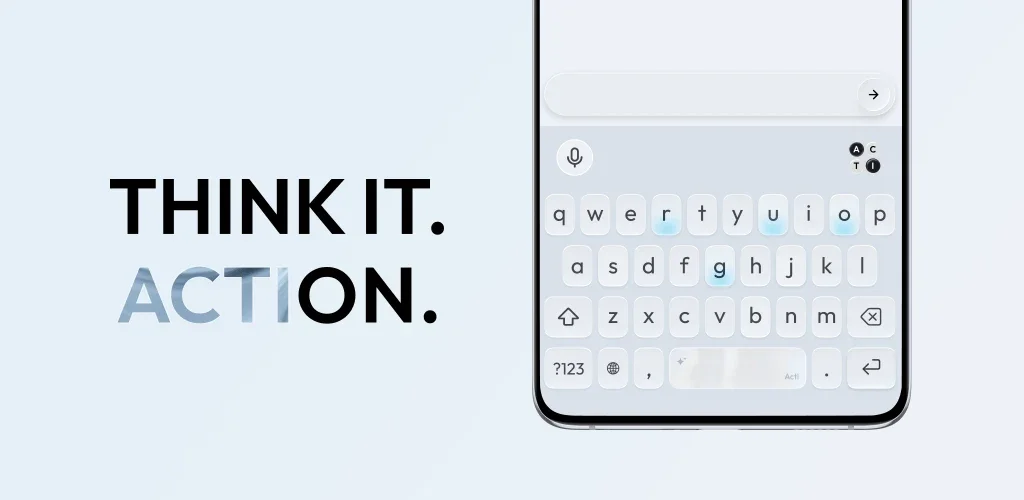
Acti sounds, at first, like a small UI trick: type what you want, hold the Acti Bar, and get a result back inside whatever app you were already using. The company calls it "the world's first agentic keyboard," and TechCrunch covered its iOS and Android launch this week as a keyboard that can bring AI actions into email, messaging, social apps, and other text fields. 1
That is a decent insight. The average AI assistant still lives in a separate room. You leave the conversation, ask the assistant, copy the answer, return to the app, paste, fix the tone, and hope nobody has replied in the meantime. Acti attacks that detour by putting the assistant at the one layer every app already accepts: the keyboard.
The roast is that a keyboard is not a neutral place to put an agent. It is the mouth of the phone.
What it actually does
Acti is a third-party keyboard with an action bar and programmable "Skill Keys." In the app-store copy, the user types an intent, holds the spacebar-like Acti Bar, and Acti returns a result, link, or action in place. The examples include restaurants, live sports schedules, Notion docs, LinkedIn profiles, Google Meet links, Calendar actions, and custom workflows. 2
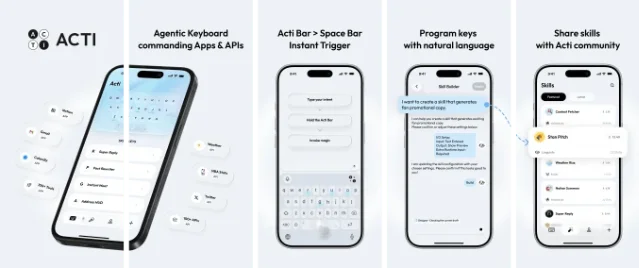
The mechanical claim is simple enough: Acti sits where typing happens, then turns selected text, clipboard content, or an explicit runtime input into an action when a user invokes a Skill. Its privacy policy says Skill execution can send the provided input, Skill identifier, parameters, session identifier, and status or error metadata to Acti services and, where needed, to AI model providers and connected tools. 3
TechCrunch reports that Acti is powered by Google's Gemini models, and that Skills behave like custom shortcuts for multistep tasks, such as translating a message or sharing a meeting link from a key. 1 The official site stretches the same idea into a full command layer: app connections, APIs, Skill Builder, Skill Hub, and a library of tools exposed from the keyboard. 4
That makes the product less like a better autocorrect and more like Zapier wearing a keyboard costume.
The pricing is friendly because the permissions are the bill
Acti is listed as free on the App Store. The iOS listing says it is only for iPhone, requires iOS 17.0 or later, and sits in the Productivity category. 2 Google Play lists the Android app with in-app purchases, a 4.4-star rating from 148 reviews, and more than 100,000 downloads. 5
Acti's own free page says the no-cost app includes the full keyboard and voice input, Acti Bar, app connections, 150+ tools, Skill Builder, and Skill Hub. 4 TechCrunch adds the business model is still forming, with future subscriptions planned for more advanced models, higher daily usage limits, and premium features. 1
So the first purchase is not money. It is trust in a keyboard that asks to become an execution layer.
Apple's privacy label says Acti may collect contact info, identifiers, usage data, and diagnostics, though the listed data is "not linked to you." 2 Google Play says the app may collect personal info, app activity, and two other data types, while also saying no data is shared with third parties, data is encrypted in transit, and users can request deletion. 5
Those labels are not scandalous. They are also not the full story. The full story is the product surface.
The privacy promise is clear, but the boundary is busy
Acti's privacy policy is unusually direct on the obvious nightmare scenario. It says the keyboard does not maintain a remote keylog, does not collect, store, or transmit typed content for storage or training, and sends text only when the user actively triggers a Skill and only for the inputs that Skill is configured to read. 3
Good. That sentence needed to exist.
The next sentence is where the work begins. The same policy says a triggered Skill can send input to Acti services, AI model providers, and connected tools. 3 It also says connected services such as Gmail, Slack, and Notion use OAuth, and that Acti calls a connected tool only when a user explicitly triggers a Skill that needs it. 3 For Google data, Acti says it does not run background polling, does not use Google user data for advertising, and does not send Google user data to AI providers. 3
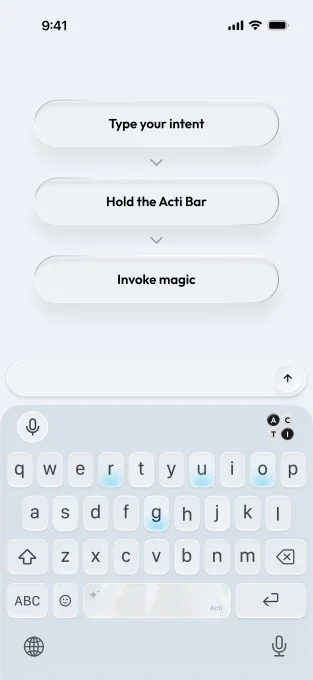
That is a careful policy. It is also a lot of plumbing to put under a long press.
The risk is not that Acti secretly reads every word. The public policy says it does not. The risk is that users will treat "hold the bar" as a small keyboard gesture when it may be a dispatch command involving selected text, clipboard content, model providers, and third-party account scopes. A tap that used to insert a letter can now ask Gmail, Notion, Slack, Calendar, or another connected service to do work.
The clever part is also the trap
The product's best argument is ergonomic. Acti's comparison page says ChatGPT is a destination, while Acti is present wherever you type, with no copy-paste round trip. 6 That is true enough. The keyboard is one of the few mobile surfaces that crosses app boundaries without asking each app's product team for permission.
But crossing app boundaries is exactly why this is not just an assistant feature. Acti is trying to turn intent into action from inside any text field. That gives it a cleaner workflow than a chatbot, and a more awkward trust model than a chatbot.
A chatbot sits in its own box. A keyboard lives underneath everything from grocery lists to work email to a half-written breakup text. Even if Acti only transmits what the user explicitly invokes, the user still has to understand what a Skill is configured to read, which account it can call, which provider handles the model step, and what the receiving app will do with the result.
That is not impossible. It is just not magic. It is admin work with nicer glass.
Verdict
Acti is a smart product idea wrapped around a brutal trust bargain. Putting an agent in the keyboard really does remove the dumbest part of mobile AI: leaving the app, asking elsewhere, and hauling the answer back by hand. But the same move turns the keyboard into a permission switchboard for model calls, OAuth tools, selected text, clipboard inputs, and public Skills. The right user is someone who already understands app scopes and wants fast command execution inside messages. The wrong user is anyone who hears "keyboard shortcut" and forgets that the shortcut now has a server, a model provider, and the ability to touch connected accounts.
References
More from this channel
Related content
- Sign in to comment.